


Wubster100
-
Posts
631 -
Joined
-
Last visited
-
Days Won
24
Content Type
Profiles
Forums
Gallery
Posts posted by Wubster100
-
-
Text sourced from @Haz
Field Effect Transistor (FET) Protection
The BCM utilizes an Field Effect Transistor (FET) protective circuit strategy for many of its outputs, for example, lamp output circuits. Output loads (current level) are monitored for excessive current (typically short circuits) and are shut down (turns off the voltage or ground provided by the module) when a fault event is detected.
A Field Effect Transistor (FET) is a type of transistor that the control module software uses to control and monitor current flow on module outputs. The Field Effect Transistor (FET) protection strategy prevents module damage in the event of excessive current flow.
Output loads (current level) are monitored for excessive current draw (typically short circuits). When a fault event is detected the Field Effect Transistor (FET) turns off and a short circuit DTC sets. The module resets the Field Effect Transistor (FET) protection and allows the circuit to function when the fault is corrected or the ignition state is cycled off and then back on.
When the excessive circuit load occurs often enough, the module shuts down the output until a repair procedure is carried out. Each Field Effect Transistor (FET) protected circuit has three predefined levels of short circuit tolerance based on a module lifetime level of fault events based upon the durability of the Field Effect Transistor (FET). If the total tolerance level is determined to be 600 fault events, the three predefined levels would be 200, 400 and 600 fault events.
When each level is reached, the DTC associated with the short circuit sets along with DTC U1000:00. These Diagnostic Trouble Codes (DTCs) can be cleared using the module on-demand self-test, then theClear DTC operation on the scan tool (if the on-demand test shows the fault corrected). The module never resets the fault event counter to zero and continues to advance the fault event counter as short circuit fault events occur.
If the number of short circuit fault events reach the third level, then Diagnostic Trouble Codes (DTCs) U1000:00 and U3000:49 set along with the associated short circuit DTC . DTC U3000:49 cannot be cleared and the module must be replaced after the repair.
-
 2
2
-
-
@HazThank you for the connector information.
I was able to take connector C2280G apart and insert a wire into pin 13 (LIN bus). Pin 4 on connector C2280F (VPWR) looks to challenging to take apart, so I will look for +12v elsewhere.
I connected power and LIN bus to my cup holder to test. Unfortunately, I was unable to get the cupholder to light up. And of course my multimeter also decided to not work! 😂 I think the battery is dead.
I was able to get the ambient light menu in the settings screen. The BCM will be a little bit trickier because I haven't found a reliable source of information on the BCM AsBuilt Data. I need to do further research and investigation into the BCM.
I would like to double check my wiring / new pin. Is there a way to test the connection to the LIN bus? Perhaps measuring the voltage or resistance of circuit VDN15 to confirm a good connection back to the BCM?
-
The BCM with fuses isn't difficult to get to. It is by the driver's area.
-
I got the cupholder with the ice blue ambient lights, but because of the LIN bus I have no way of powering the lights. Unfortunately, as I was checking the connectors on my BCM, I do not have any wiring for ambient lights. 😓
Pin 13 on connector C2280G (LIN bus for cup holder) doesn't look too difficult to add a wire onto. The more challenging connector looks like pin 4 on connector C2280F (VPWR).
@HazThank you for the requested documents. Do you have a pinout for C2280F, as well as a service pigtail part / information for pin 4.
-
@Haz Can you please provide a BCM pinout of the C2280D connector?
-
15 hours ago, SV101 said:
I bought a new bracket, but still need to install it. I am hoping the sensor is still good. It sends out collision alerts when I am near cars on the left, so I am assuming it is ok. I think the sensor is facing left with the broken backet. Assuming the sensor is not damaged, do i need Forscan to recalibrate?
Since you are not receiving any major DTCs and still receiving collision alerts, the CCM is probably still good. To calibrate the sensor, the vertical calibration is done by physically leveling the sensor. The horizontal calibration is done in FORScan. You just need it to point straight to the best of your ability. Calibration in FORScan is not required. When I got my CCM used, it didn’t need calibrated. Though, I would recommend calibrating the CCM if it gets moved at all. It is a simple process in FORScan, you only need to drive around for about 5-15 minutes and it will calibrate.
I would recommend calibrating as the software is free and the cable is at a very reasonable price.
The collision alerts will come from a combination of the CCM, and the IPMA camera and LiDAR system.
-
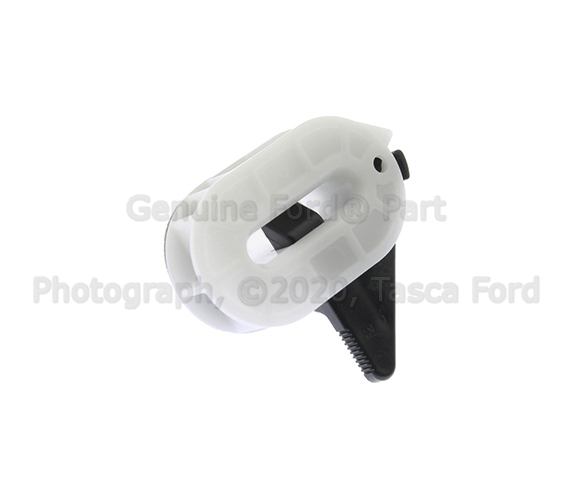
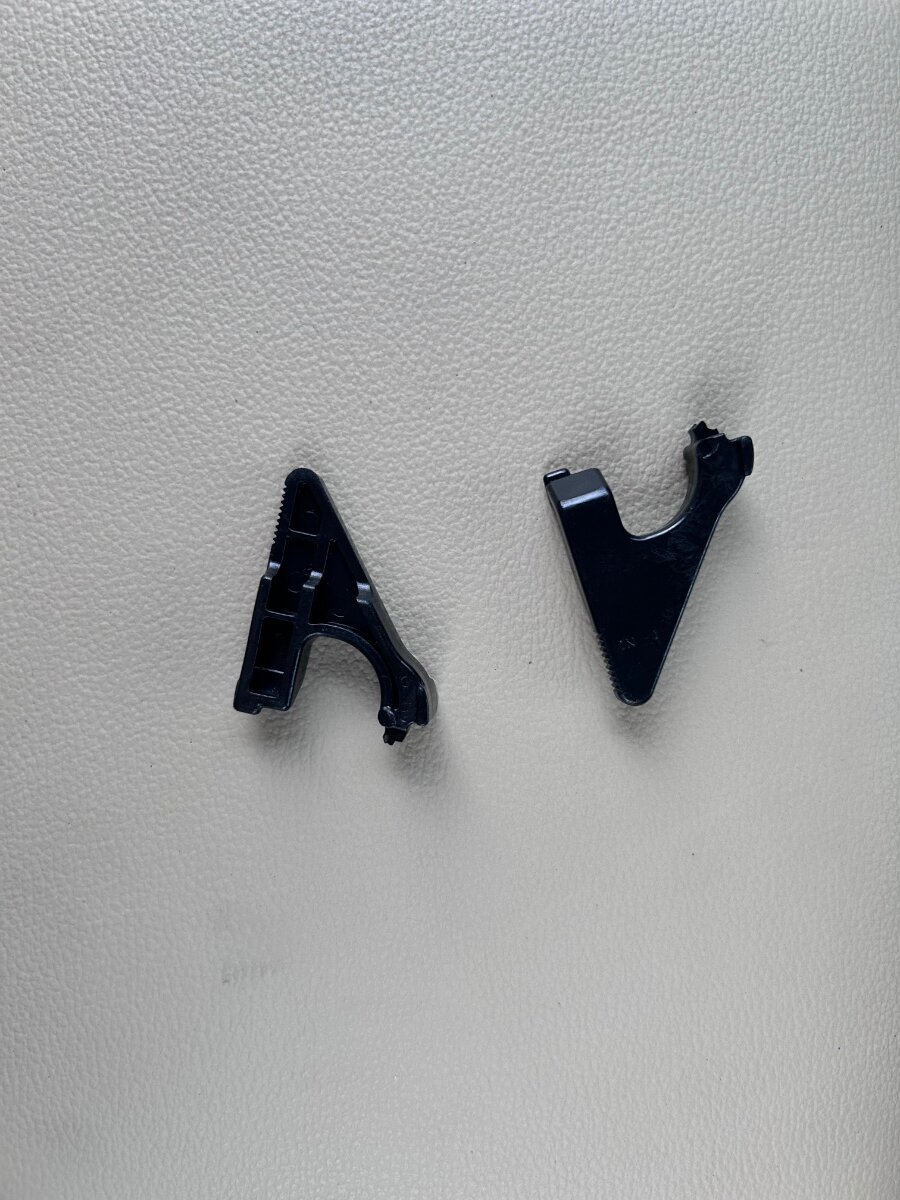
I might need to get 2 new clips.
-
Could the locking clips be broken?
-
I am using SW-8183 (DG9Z-9C888-GC) This does not have lane centering. It has a LIM button but I haven't enabled it or tried to use it.

-
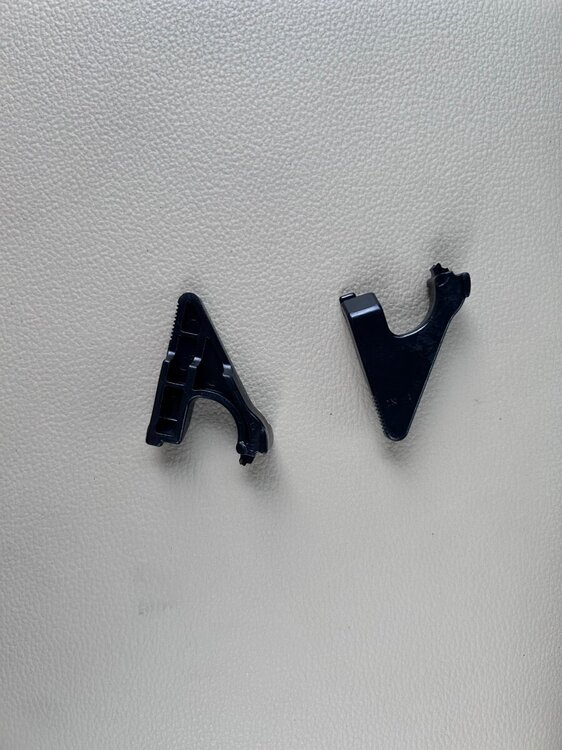
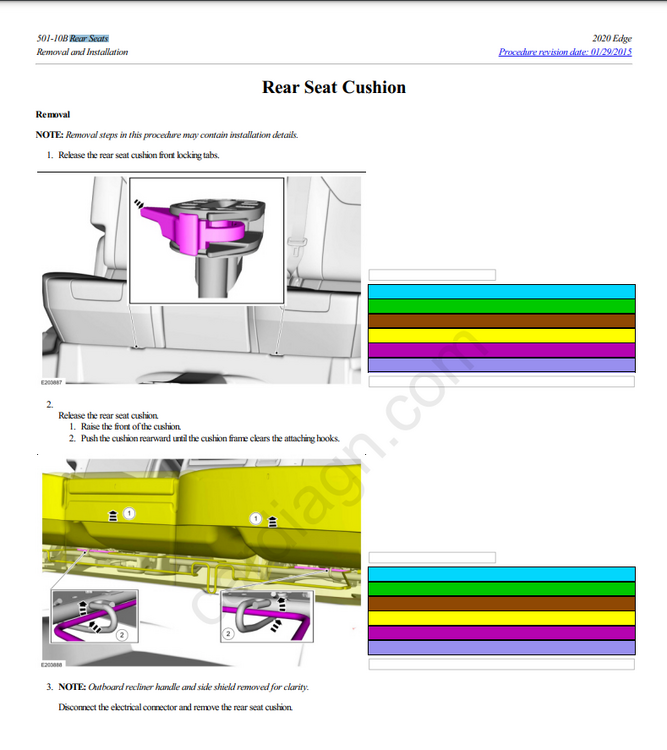
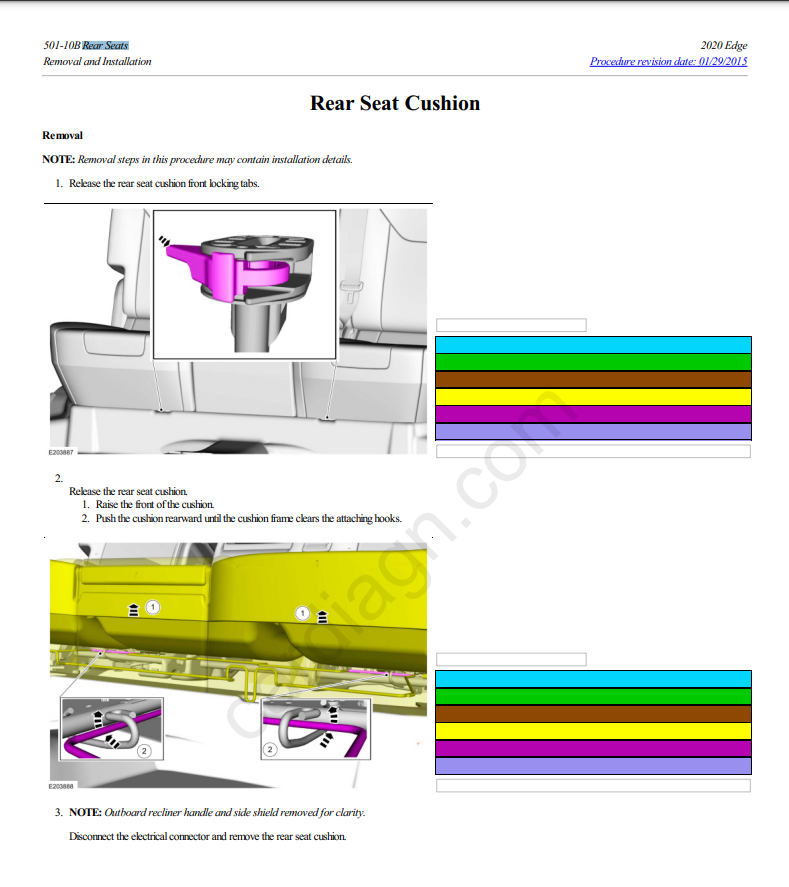
One of my passengers lost their airpod inside of the rear seat cushion where the seat belt latch is. We were able to remove the locking tab and lift the rear seat cushion up. Now, the rear seats are loose and I can't figure out how to lock them in place again.
-
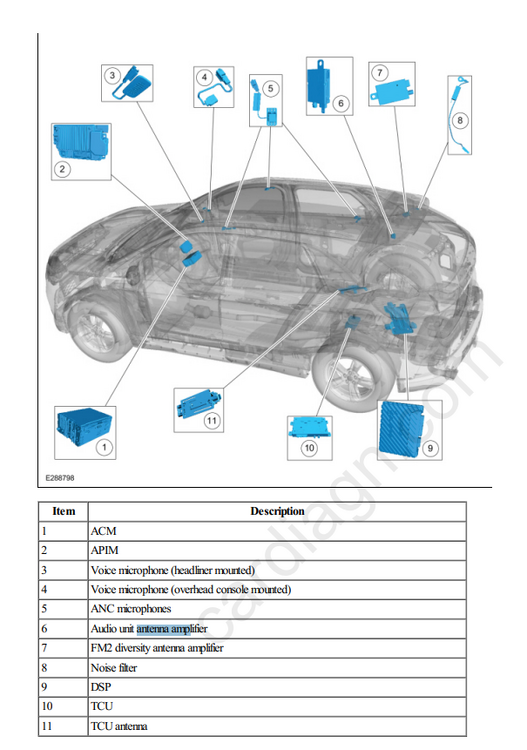

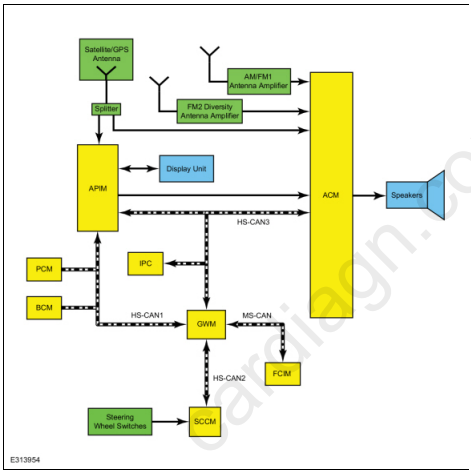
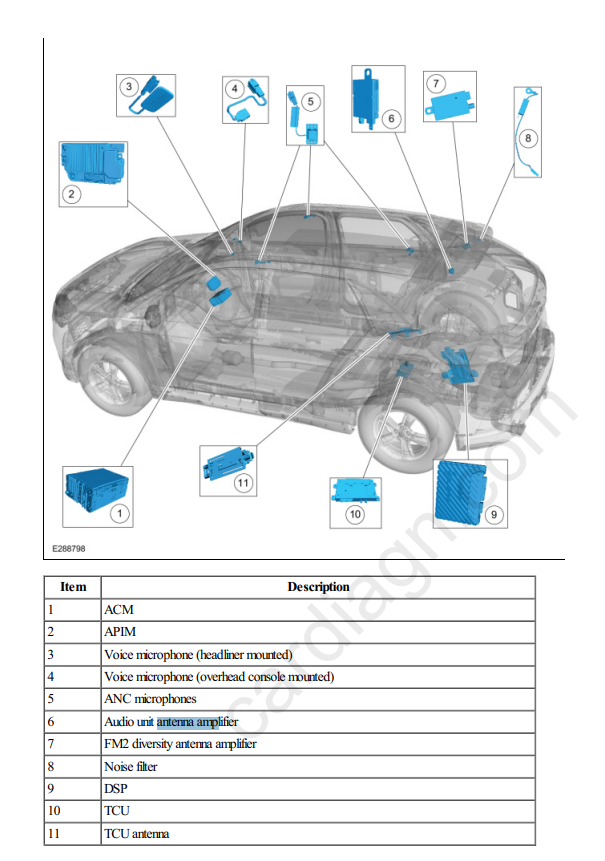
AM/ FM Radio
When the AM/ FM mode is selected, the radio amplifies radio waves sent from the antenna. It then selects the requested frequency, converts and
amplifies the content. These fluctuating audio signals are output as AC output voltage to power the speakers or as an input to a separate amplifier.
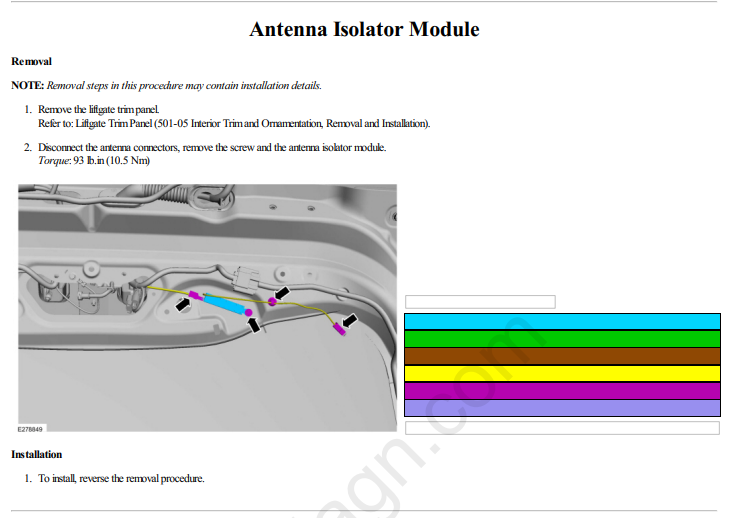
If equipped with a FM2 diversity antenna, FM radio waves are collected and sent to be amplified by the FM2 diversity antenna amplifier. A
coaxial antenna cable sends the amplified signal to the ACM. An ACM antenna signal comparator uses both antenna signals to reduce or eliminate
FM distortion in poor signal environments.If equipped with HD Radio capability, the radio will automatically detect and playback the improved sound quality and multiple programs of HD
broadcasts.AM/ FM1 Antenna
The AM/ FM1 antenna (also called the audio unit antenna) is an on-glass antenna, mounted to the left side of the rear window. It receives AM/
FM radio waves and sends them through the audio unit antenna amplifier to the ACM via the audio unit antenna coaxial cable (also called the AM/
FM1 antenna coaxial cable).
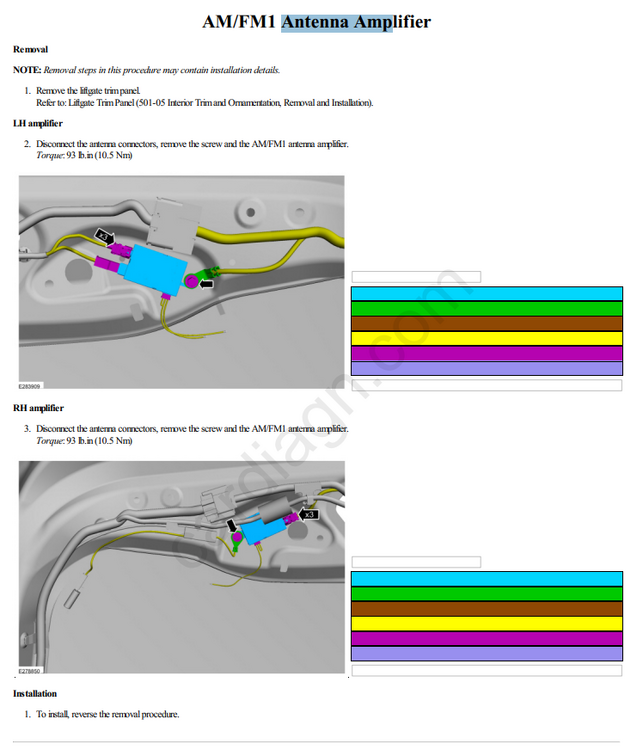
AM/ FM1 Antenna Amplifier
The AM/ FM1 antenna amplifier (also called the audio unit antenna amplifier) amplifies AM/ FM radio signals to improve reception. The amplified
signal is sent through a coaxial cable to the ACM. The amplifier is powered by the ACM through the coaxial cable.
FM2 Diversity Antenna
The FM2 diversity antenna is an on-glass antenna, mounted to the right side of the rear window. The FM2 diversity antenna improves FM
reception in urban areas or anywhere large objects reflect FM signals and create multiple FM signal paths.
FM2 Diversity Antenna Amplifier
The FM2 diversity antenna amplifier amplifies FM radio signals and transmits them through a coaxial cable to the ACM. Voltage for the amplifier is
provided by the ACM through the coaxial cable.
GPS/Satellite Radio Antenna
The GPS/satellite radio antenna contains a GPS antenna circuit board that receives radio waves containing GPS and satellite radio data (vehicles
equipped with a satellite radio). The data is sent through the coaxial cable to the APIM ( GPS data) and through a splitter to the ACM (satellite
radio data).
Cellular Antenna
If equipped, the audio unit antenna contains a cellular antenna circuit board that receives radio waves containing cellular data. The data is sent
through the cellular antenna coaxial cable to the TCU.
TCU Antenna
The TCU antenna is used is used to boost reception for incoming and outgoing cellular network data. It is a compact, cellular phone type, planar
inverted-F antenna-
1
-
-
The "sail" on the roof is the satellite radio antenna.
-
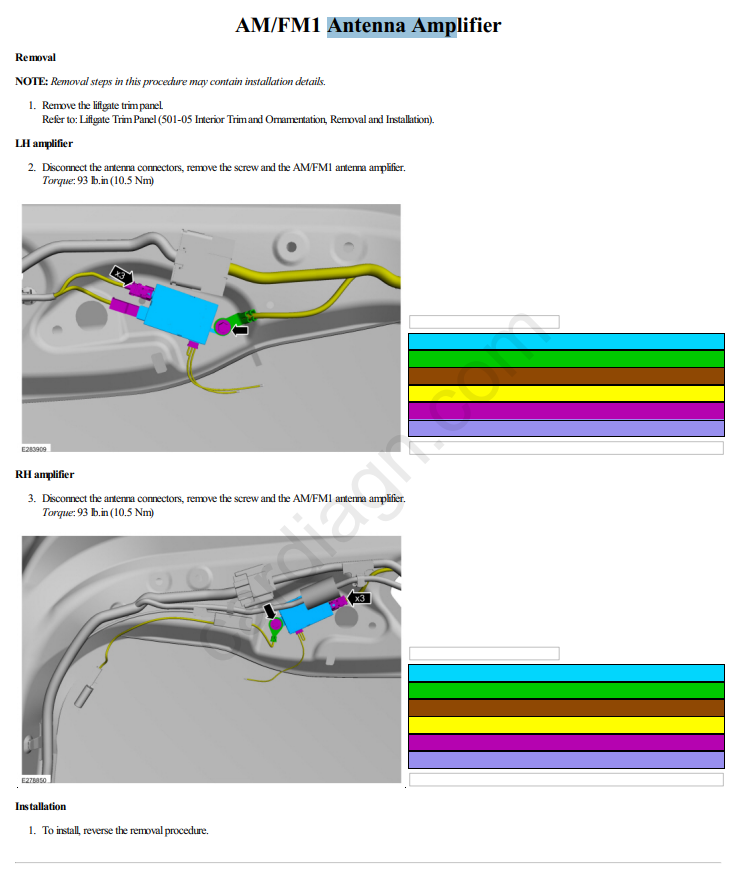
AM/ FM1 Antenna
The AM/ FM1 antenna (also called the audio unit antenna) is an on-glass antenna, mounted to the left side of the rear window. It receives AM/
FM radio waves and sends them through the audio unit antenna amplifier to the ACM via the audio unit antenna coaxial cable (also called the AM/
FM1 antenna coaxial cable).
AM/ FM1 Antenna Amplifier
The AM/ FM1 antenna amplifier (also called the audio unit antenna amplifier) amplifies AM/ FM radio signals to improve reception. The amplified
signal is sent through a coaxial cable to the ACM. The amplifier is powered by the ACM through the coaxial cable. -
APIM is for the touchscreen
IPC is for the instrument cluster
-
-
5 hours ago, Koz57 said:
I just took delivery on a new 2024 Edge Titanium (301A package) with SYNC 4A. As far as I can tell, there is no Brake Hold option available in any of the vehicle settings. Also, there is not a button on the console to activate it. I called Ford support, they were no help at all. The owners manual contains the instructions on using it, but it does not correspond to what is available on the touchscreen.
I tried to get it to work a little while ago, but one of my modules, it might have been ABS, I don’t remember which one, was unable to support auto hold. I could not get the auto hold switch to appear on screen. I don’t have the latest version of Sync 4. The Lincoln Nautilus has auto hold though.
-
25 minutes ago, PatrickGuinalia said:
Hello friends, I bought my Edge 2014 3.5 AWD Titanium just over a month ago and today I read all the pages here in this topic.
However, I didn't find any option that works to enable climate control with ForScan on the right screen.
Is there such a possibility, or only on Edges 2015+?
Have you tried searching for climate repeater in FORscan? It should be under IPC configuration and programming.
-
Can the CD be digitized?
-
Why do you need to go through the firewall? What is the goal of the project?
-
Does the static happen while bluetooth and WiFi is enabled? Could there be confusion with bluetooth only vs. carplay/android auto?
-
1 hour ago, NellyT said:
Would anyone know if a 2023 edge st honeycomb grill will even swap with a 2023 titanium grill?
Here is how to remove the front grill:
https://youtu.be/4ZjwjQ5wTEE?si=w6MsHoVeQ8puWoty
-
It looks like auto hold gets switched on and off through the APIM rather than a physical switch.
-
1
-
-
Has anyone used auto hold? Is it a feature for North America or other regions?
From the WSM:
Auto Hold
The auto hold feature is activated and deactivated through the use of the auto hold switch. For the system to activate, the vehicle must not be
moving, the driver safety belt must be buckled and the driver door must be closed. The ABS receives the driver safety belt buckle status from the
RCM, driver door status from the BCM, brake system pressure and the wheel speed sensors allow the ABS module to determine if the vehicle is
stopped. Once the previous conditions have been met the auto hold feature can be activated. Once the auto hold feature is activated, the driver
presses the brake pedal and the ABS module closes the isolation valves in the HCU to maintain the current brake system pressure at the wheel
ends. The ABS module maintains the pressure until the driver presses the accelerator pedal, shifts the transmission into PARK or after a specific
time limit has been reached. The ABS module engages the parking brake after 2-10 minutes, depending on the grade of incline the vehicle is
currently stopped on, the steeper the grade, the shorter the time.
-
If you have trailer wiring from the factory, the wiring will connect to a trailer tow module.
Paddle Shifter add on
in Accessories & Modifications
Posted
If you are going to replace your steering wheel, then you might as well look for one that is heated too.