
Samurai Edge
-
Posts
246 -
Joined
-
Last visited
-
Days Won
33
About Samurai Edge

Samurai Edge's Achievements

Community Regular (8/14)
-
 Rare
Rare
-
 Rare
Rare
-
 Rare
Rare
-
 Rare
Rare
-
 Rare
Rare
Recent Badges
-
I would guard against this. Even if he took the actual white plastic baffle and went to install it in the aluminum pan, the only apparent way to attach the baffle would be to screw it to the pan. The pans are not that thick so that would most likely crack the pan or cause an additional point of leakage. Another possibility would be something like JB Weld, but I don't know how such a product would last being submersed in oil, even hot oil, in it's lifetime.
-
I don't think this would solve the issue. One would think it would not hurt. You would still be missing the point of the white plastic baffle which is to hold a quantity of oil in a specific area of the oil pick up. Which raises another question: I could not find an oil pick-up tube in the parts drawings anywhere for this particular pan. Does this connect directly to a port on the bottom of the engine or is there indeed an oil pick-up tube? If there is indeed a pick-up tube, then there is another possibility that there is a loose connection of the pick-up tube to the motor OR that pick-up tube may be cracked, leading to a loss of pressure especially under high flow, like hard acceleration.
-
I don't know where you got that info on the differences in dyno numbers between 87 octane. 15 - 17 HP compared to what? As far as my reasoning for staying with 93 octane: - Yes, there is a felt performance difference - More importantly, the motor just runs better overall - Smoother, more responsive, etc.
-
I was wondering if there was something like that. Good idea! 💡
-
This looks like your oil pan: https://ford.oempartsonline.com/oem-parts/ford-oil-pan-ft4z6675d What I am not seeing / finding is an oil pan pick-up anywhere I look. That could be the problem right there. The oil pick-up, being smaller on the aluminum pan sounds like the culprit. A smaller than designed oil pick-up could create an oil starvation issue, but that's my thought. When you look at the oil pick-up area on the OEM pan, it looks like that white " plastic cover " creates a larger area for the oil to gather for pick-up into the motor. The aluminum pan has no such area but pick up directly from the open pan area. A typical oil pick-up has section at the end of the pick-up tube that sits bathed in the oil to suck in the oil in the pan. I think the OEM white " plastic cover " is that section I described above which is clearly missing from the aluminum pan. Presuming you didn't change anything else, looks like you know your issue.
-
Horrible layout and adds galore, why?
Samurai Edge replied to Summers22's topic in Forum Help & Site Suggestions
I do not use this forum on a mobile. My mobile, a phone, is a phone. Phone screen is too small for such things as this forum. -
I have found that TRQ makes good videos. Informative and easy to understand. And, yes, I already have that removal tool, and others. They work really well.
-
I notice the difference when I had normally-aspirated vehicles. I also notice the difference in my outdoor power equipment. To me, it's worth the extra expense over a lower octane fuel. Luckily, we are not at $6 / gallon for 93 octane, yet. But we are getting there 🥲
-
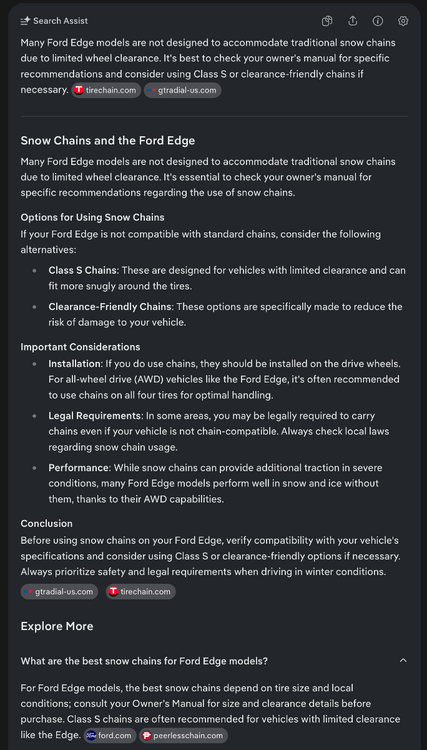
Did you research any information on snow chain usage on the Ford Edge before asking his question? Here are a coupe of answers: https://www.ford.com/support/how-tos/ownership/customers-ask-ford/should-i-use-tire-cables-or-chains-with-my-vehicle/ But, you live in Irvine, CA. so what type of conditions are you expecting in Southern Cali?
-
Horrible layout and adds galore, why?
Samurai Edge replied to Summers22's topic in Forum Help & Site Suggestions
Facebook will not be the same as this forum. Thankfully, I hate social media and won't go there AND I work from a desktop 🙂 -
Why are you concerned shifting down to 87 octane? The cost of fuel? I only use 93 octane ( easily available her in the NE ) for two reasons: - 1. I have always found the engine runs better on the higher octane - 2. Having turbochargers makes it even more important, to me.
-
Another good possibility. Could be one of the half-shafts. Could be the bearings in the driveshaft as well. Or the U-joints. In my experience, it was the TSM that was causing the issue the OP described. I would check all the potential points before spending any money. To check any of the half-shafts or the driveshaft, one has to get under the car and physically move the half-shafts / driveshaft around to determine just how much play / movement ( Up / Down / Side-to-Side ) there is. A little play is expected / normal. A lot of play is abnormal. Should be fairly obvious.
-
You have to supply a LOT more info if you expect to get any reasonable help. Right now, no one has any idea what the issues are
-
The " clunk " you hear is most likely the Torque Steering Mount ( TSM ) ( pretty sure that is the right name ) which connects the engine to the transmission. It has an aluminum body with soft rubber fillings. Definitely not a chew toy. As the rubber ages, it gets softer, allowing more movement when shifting between gears. Easy solution is to not shift too quickly between any of the gears, like Park to Reverse to back out of your parking space. Option is to install a new TSM. I think they are around $100 USD available from any Ford Dealer or there are aftermarket replacement versions. Easy to replace BUT if the mounting bolts are rusted in place, you need someone with the right tools and torch to get that darn bolt out.
-
Mistro399: Did you ever solve this problem? To both Mistro399 and Cossie: You didn't state under what conditions the engine shut off has occurred. Were you driving in a straight line or taking corners when this issue rises? I have no idea what specific aluminum pan you are both referring to but it sounds like a possible oil starvation issue. Not knowing the specific internal design of the aluminum pan vs the OEM pan leaves a big unknown. Just because something will fit does not necessarily make it a good choice.